Wednesday, August 3, 2016

Journey Up to the Redwoods - Part 2

Continuing up Hwy 1, we discovered the amazing Elephant Seals. I somehow missed learning about them. Apparently, they were thought to be extinct in the 1880's due to hunting. However, a small colony survived off Baja California. In 1990, the Elephant Seals starting arriving at this beach. Pups were born. Now, this beach, Piedras Blancas is the largest rookery on the mainland.
They spend most of the year out at sea but they have seasons on shore for breeding, giving birth and molting. This seemed to be the molting time for young males. Most of the ones we saw were resting.
A few were roaring.
We saw one in the ocean with a huge gaping mouth. They are so unusual! A cross between a seal, an elephant and a hippo....
Nearby, we saw a couple of spiffy Black Oystercatchers.
Once again, our time was limited so we continued on our journey. I was constantly surprised that as the hours passed by, I never got bored. The drive is truly a feast for the eyes. It is the most beautiful highway that I have ever driven.
Mountains line the east side while the turquoise ocean is on the other side. It's hard to believe that this beautiful stretch is now threatened by the Soberanes fire. Sadly, this fire which at the time of this writing has consumed 40,000 plus acres was started by an abandoned illegal campfire!!

This long day of driving ended shortly after seeing the tiny little lighthouse under the Golden Gate Bridge and crossing the bridge just as the sky was darkening.
Being a birder, it was essential to stop at Bodega Bay. You many not remember the name of this place but I'm sure you remember Alfred Hitchcock's movie, "The Birds". Bodega Bay is where the movie was filmed. Since it was a foggy day, we didn't see many birds or much scenery...
 
 ..but we did see some old photos and the famous schoolhouse in the movie.
After another 4 hours, we reached our destination, Humboldt Redwoods State Park. What a special 
place! 
 We slept under the majestic silent giants for 3 nights. These magnificent trees can reach 365-379 feet in the air. At that height, it's a hidden world up there.
 We half expected to see some gnomes or fairies in this dark forest. None to be found.


Near a running stream, we did spot this American Dipper. It's a plain looking bird that gives you a flash every time it blinks since the outer lid has white feathers on it.The extra eyelid, nictitating membrane, is used for swimming underwater to enable it to look for aquatic insects and larvae. This was my first sighting of this unique songbird so it was pretty exciting to find.

Like most vacations, ours came to an end too quickly. We came home with great memories and an appreciation for the coast and northern section of the state, and one souvenir from Bodega Bay.

We wish all of the firefighters the best as they battle the blazes that are destroying  beautiful parts of our country.


Click on photos to enlarge.
Photos and content by Robin Roberts.


Thursday, July 28, 2016

Discoveries Along the Pacific Highway - Part 1

Instead of returning to the majestic Sierra Mountains this summer, we decided to take the recommendation of a good friend who encouraged us to discover the beautiful sights along the Pacific coast and to experience camping in the Redwood forest.
After 7 hours of driving from Idyllwild, we arrived at Montana de Oro State Park for our first view of the Pacific Ocean off of Hwy 1. Wow!
The tilted layers of rocky formations are a result of the Pacific Plate grinding against the North American Plate.


All night long we heard the crashing waves against the rocky shoreline. Much better than a sound machine!!

Our time here was much too short. Early the next morning when the fog still shrouded the coast, we startled a California Quail family on an inland trail.
 The bright orange Garden Nasturtium flowers were quite striking. The hummingbirds thought so, too. According to the local wildflower book, this area is home to 290 wildflowers.
Before leaving the area entirely, we stopped at nearby Morro Bay. 
As we arrived, the fog started to lift revealing Morro Rock, a protected sanctuary. It was covered with thousands of birds including Western Gulls, Brown Pelicans and various Cormorants. We saw a perched Peregrine Falcon on one of the ledges. No doubt there were others hidden from our sight.
Along the beach, a couple of Long-billed Curlews kept their distance from the surfers braving the cold water.


In the protected bay, we found a "raft" of Sea Otters. This raft was made up of females and their pups. They "anchor" themselves by wrapping their bodies with kelp in order that they can take a nap. Since they aren't insulated with blubber like whales or seals, they need to keep their fur as dry as possible to stay warm. When they nap, they hold their front paws and hind flippers up and out of the water.
The most precious sight,however, is to see a mother Sea Otter clutching her pup to her chest during naptime!
Once again, a couple of hours at Morro Bay was just enough for us to see what a special place that it is and instill a desire to return one day. The journey continues....

Click on photos to enlarge or to watch video.
Content and photos by Robin Roberts.


Tuesday, July 5, 2016

Summer in the Mountains

Summer in the mountains is like most places. Flowers are blooming, baby birds are in nests with extremely busy parents and others that have left the nest are learning the art of foraging. Of course, insects of all sorts both annoying ones that fly down your throat or bite every exposed part of your body and those that are quite harmless and interesting abound.

 Beginning with nesting birds...I LOVE finding hidden bird nests. Recently, I discovered the tree cavity nests of both the Western Bluebird and the Violet-green Swallow. The tireless adults bring insects back and forth to the nest but if they sense your presence, they will pause in order to protect the identity of their nest location. Keep that in mind if you find a nest. Back off so the birds can deliver their food.

We've been watching the sole pair of Bald Eagles at Lake Hemet since the winter when they began nesting. The whole process takes months for them. Last week, I finally saw the young Bald Eagle leave its birth tree. It landed on the shore. It seemed to be more interested in getting used to the water than fishing. I wish I had closer photos but the eagles were on the opposite side of the lake.
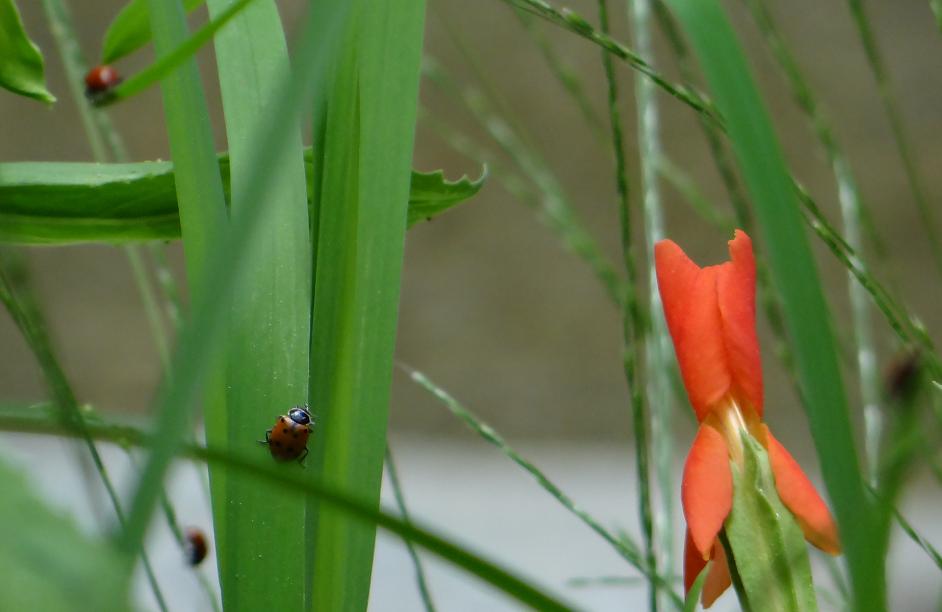
As for insects, three stand out this week. First, it was fun to see the ladybugs on a fresh Scarlet Monkey Flower.
We found this incredibly fat Monarch caterpillar munching the leaves of a California Milkweed. It reminded me of the children's story, The Hungry Caterpillar.
The other day, we found a swarm of honey bees. Evidently, the Queen and the majority of the worker bees left their original colony with plans of starting a new one. It was quite an impressive site! Thousands of buzzing bees gathered onto a branch and ended in this formation.
Spring rains have temporarily filled the creeks and have stimulated the growth of beautiful wildflowers.
Flowing water and blooming flowers are a beautiful sight that we don't take for granted. Unfortunately, the mountains didn't get enough snow this winter to alleviate the drought. With the hot summer and lack of rain, fire warnings are high once again.

We are once again volunteering in Tahquitz Fire Lookout Tower keeping watch and hoping our mountains will be spared from another large wildfire.

Hope you are enjoying your own birds, insects and flowers in your patch of the world!


Click on photos to enlarge.
Photos and content by Robin Roberts.


Wednesday, June 22, 2016

Drinking and Dust Bathing - Mountain Quails

When we moved into our new home in January, I was sad to say "Good-bye"to the Mt Quail families that had visited us in our previous home in the woods. I doubted we would be lucky enough for them to visit us in our new home.
Fortunately, my doubts were not realized! This week we have had a daily visit by an adult and his/her 4 chicks!
The sound of bubbling water in our water dish was probably the key to their initial visits. 

We also have a yard that is in progress..We are adding native plants one by one but we have a long way to go. There are still lots of open patches of dirt. This must be an enticing feature since the quail family discovered soft dirt to bathe in. In arid places, dust bathing is an alternative to water bathing. The dust helps expel excessive oil and dry skin. Maintaining feathers is essential for a healthy bird. This 6 minute video captures an adult Mt Quail enjoying wallowing in the dirt followed by his/her chicks joining in the fun one by one. Funny how they don't mind being squashed next to each other. Enjoy!


Tuesday, June 14, 2016

Chaparral to a Conifer Forest - Thomas Mountain

Finding a Lazuli Bunting was why my day started at 4:30am. It is a summer resident in the San Jacinto mountains but until a month ago, I had never been able to see one. My goal on this day was to find one and get a photo..no guarantees.
Thomas and Little Thomas Mt are easy to overlook when you drive through Garner Valley since you tend to look at the taller, majestic mountains on the opposite side of the valley. These mountains have their own unique beauty.
To reach the mountain peak, you follow a narrow, dirt USFS road and hope you don't encounter too many people driving in the opposite direction. Ribbonwood, Chamise and Scrub Oak dominate the chaparral landscape until you reach the higher elevation.
Black-chinned Sparrow
Western Scrub Jay
There is a huge diversity of birds that call this habitat home. The Black-chinned Sparrow is a summer resident but the Scrub Jay is here all year round.
When we reached the peak, the air was filled with blooming flowers mixed with the vanilla scent from the Jeffrey Pine trees.

Today was my lucky day! The first bird that I saw after reaching the top was singing from the tallest snag overlooking the valley far below. It was the beautiful, turquoise feathered Lazuli Bunting! I had hoped for a closer, clearer photo but I was happy to at least catch a glimpse of this bird!
Last year when we were here, there was a meadow filled with California Poppies and Lupine. This year, the invasive grass dominated the meadow.
 In other areas of the mountain, we saw unfamiliar Mariposa Lilies in bloom.
A nice surprise was finding a couple of Lark Sparrows. Sparrows are generally hard to distinguish from each other but this sparrow has a striking facial pattern so it's easy to recognize.

It was  great to see a patch of one of my favorite summer blooming flowers, the Prickly Poppy. If you look close you can see a cute little bug peeking over the petals. 
Wishing you some peaceful, inspiring moments in Nature this Summer.

Click on photos to enlarge.
Content and photos by Robin Roberts.