Sunday, April 26, 2020

Nighttime Prowlers

Who is prowling around your house at night? 
In the last month or two, we have captured a couple of cute prowlers.


Racoon, grey fox....


Mountain Lion by Dave Pelham

Our friends, Dave and Barb, however, have a strong, healthy mountain lion traveling
 through their yard.

Celebrate the wildlife day and night!

Photos and content by Robin Roberts
Click on photos to enlarge.

Saturday, April 11, 2020

Spring Snow

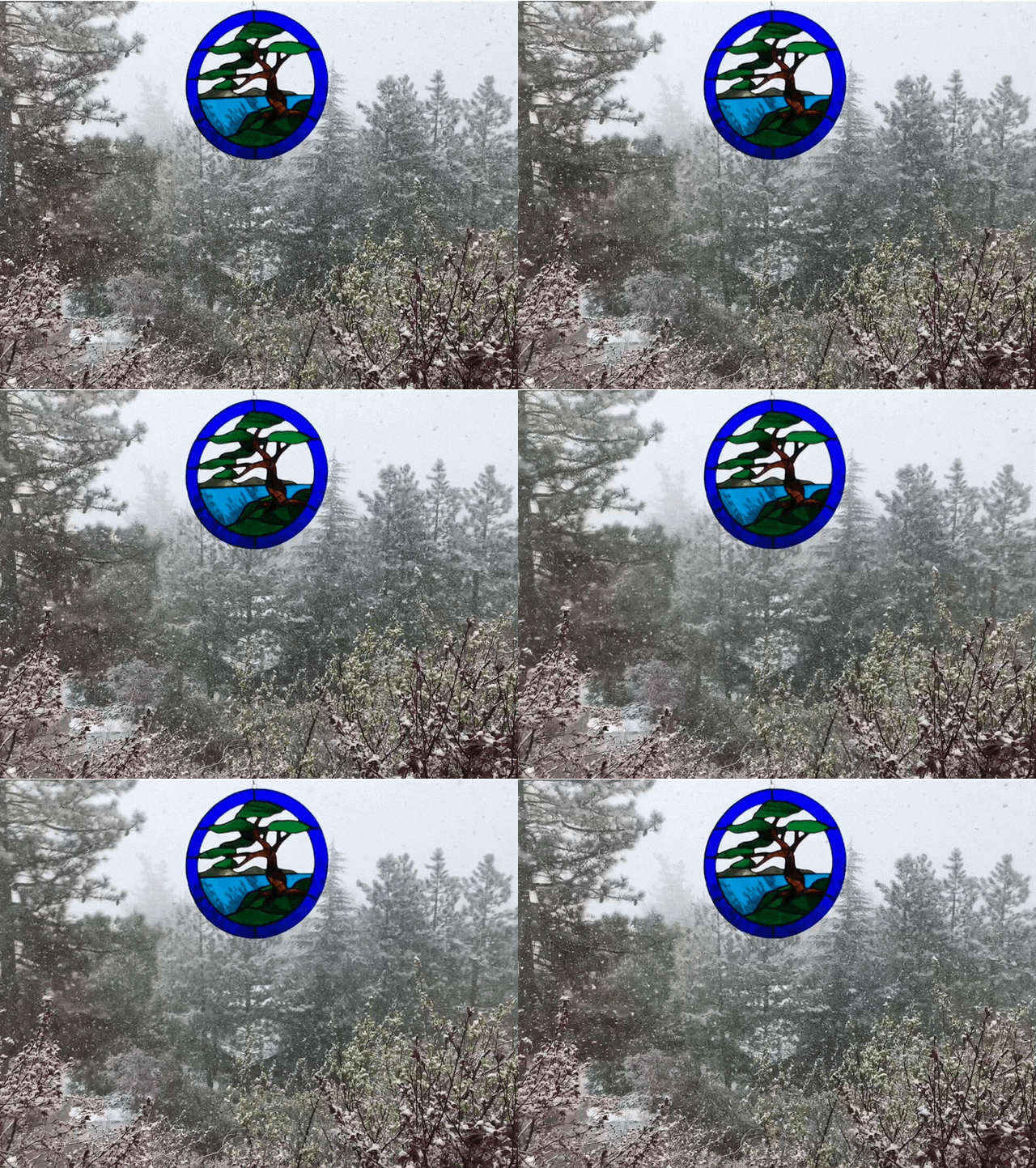
What a week! Spring has definitely been put on hold. With days of snow, it felt more like a winter storm in January or February. Marcia, a good friend, described it perfectly when she said that watching the huge snowflakes fall outside her window was like being inside of a snow globe. Perfect analogy!
What a beautiful sight! Snow on the mountains! Having lived in this area during a drought and wildfires, late winter or early spring snowstorms are a gift!
With this scene out my window one morning, my first task was to knock off all the feeders especially the hummingbird feeders.
Thanks to the early Spring blooming manzanitas, the hummingbirds have an alternative if the supplemental feeders are covered in snow. What a relief!
White-breasted Nuthatch (Sitta carolinensis)

Mountain Chickadee (Poecile gambeli)

What better time than now to get to know the birds in your own backyard. The snowy conditions brought lots of frequently seen birds along with some infrequent visitors.

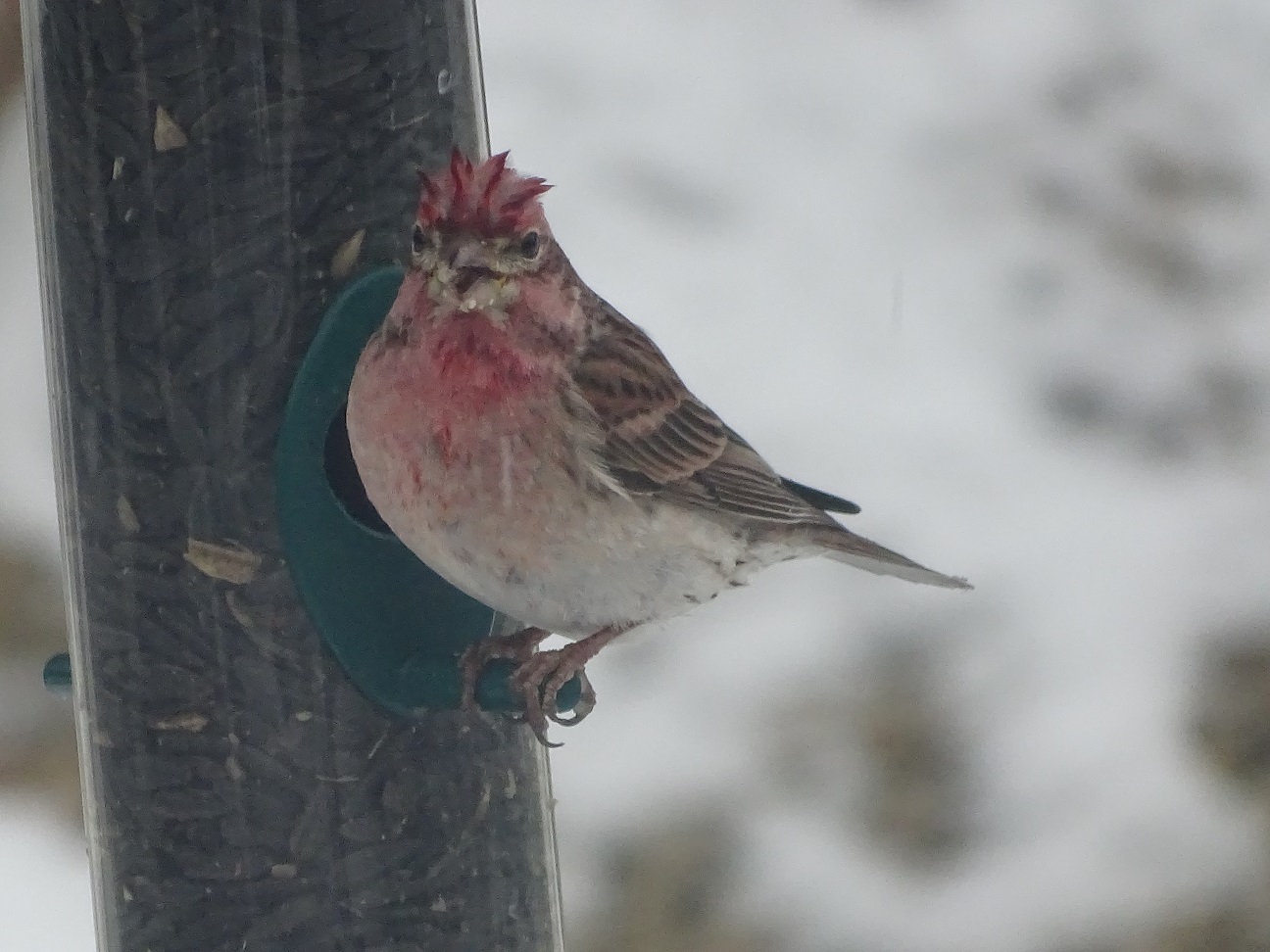
Cassin's Finches (Carpodacus cassinii)
These beautiful pink-tinged males are usually found in the high country but sometimes in the winter, they can be found downslope in our area. Seven of these finches found our backyard feeders this week. I suspect that they will head up to the high country as the snow starts to melt.


The temperatures will warm and the snow will melt but for now, we are enjoying the last fires of the season.

This quote is on a plaque in a turnout on a windy, mountain road to the desert. It is a reminder for people to be careful as they drive down the steep mountain. I read it recently and thought it was appropriate to share now in light of the pandemic.

"Maintain a grateful awareness of the time given you to share with your loved ones
And remember those who innocently lost what you may take for granted."

For a beautiful musical message of hope and healing by Andrea Bocelli from Milan, go to
Andrea Bocelli


Click on photos to enlarge.
Photos and content by Robin Roberts.


Monday, April 6, 2020

Spring isn't Canceled


What a relief! Spring is marching on despite the terrible pandemic.


It's a little slow to arrive up here in the mountains. We thought it was officially here last week, but as you can see by the current forecast, we may end up doing some shoveling before the week is over.

Anna's Hummingbird (Calypte anna)

It's been an exciting week at the hummingbird feeders. Our beautiful resident Anna's hummingbird has had to share the feeder with migrants and other returning hummers.


Calliope Hummingbird (Selasphorus calliope) by Adam Roberts

This Calliope hummingbird found our feeder on its long journey. These birds are the smallest breeding North American birds and they are the smallest long-distant migrants (Calder, 2020). Imagine they spend the winter as far south as Mexico and some travel as far north as Canada to nest. As you can see by the previous photo, they can be overlooked when they are sharing a feeder with other hummers but they are smaller if you compare sizes.


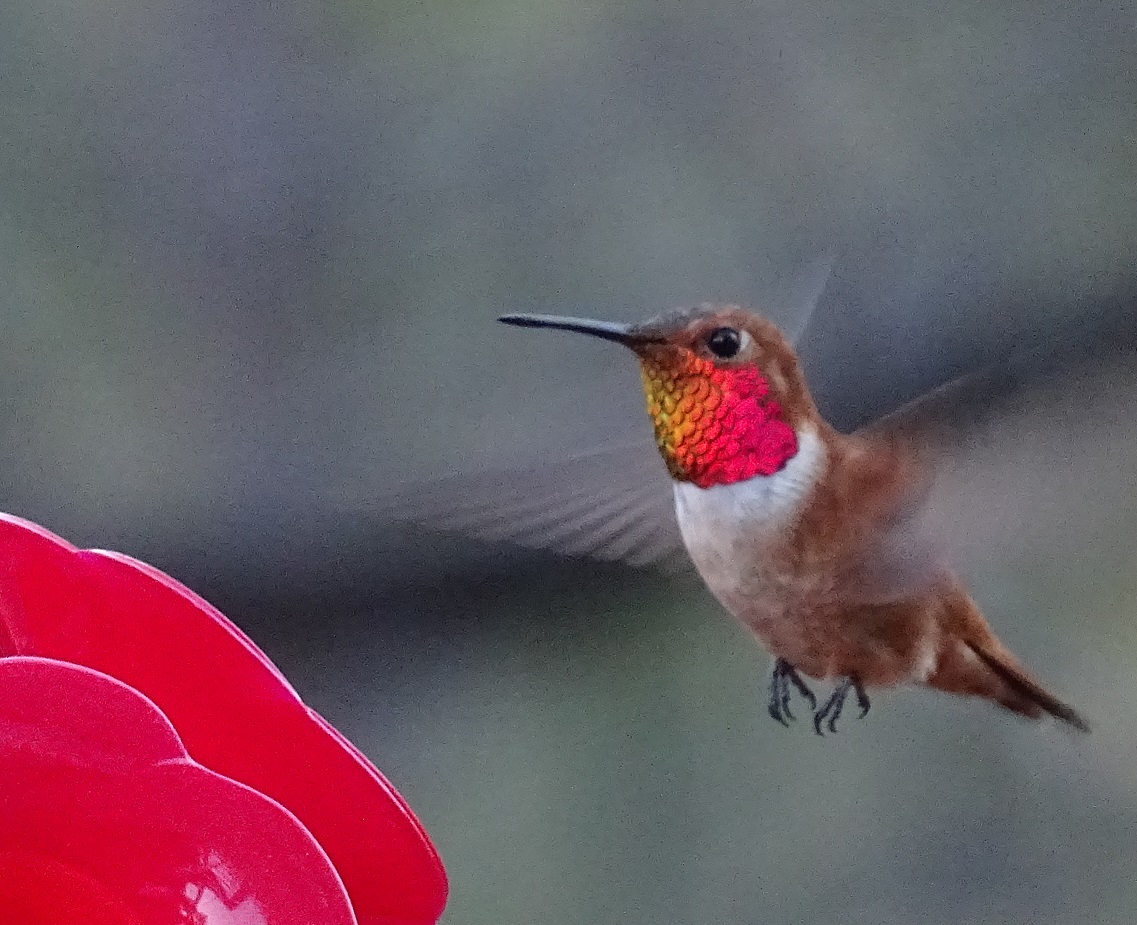
Rufous Hummingbird (Selasphorus rufus)

During the same week, a few of these bold hummingbirds arrived. They are quite determined to fill up on the nectar with good reason. They, too, have a long migration route each year. These birds travel to the northwest and Canada each year to nest.


Black-headed Grosbeak (Pheucticus melanocephalus) by Dave Pelham

The other exciting new bird of the week is the black-headed grosbeak. It showed up both in our yard and our neighbor's nearly simultaneously. These are the birds that bring beautiful songs to our forest every morning. They have returned from Mexico to breed in our mountains. Lucky us!

California Scrub-jay (Aphelocoma californica)

This pair of jays that live in our yard aren't too thrilled with the new arrival. Hopefully, the grosbeak will persevere. Although the scrub-jays are quite intelligent, they sure aren't as musical as the grosbeaks.

Western Grey Squirrel

As I sit here working on my blog post, this cute furry squirrel has been gobbling up all the birdseed that is out for the birds. Normally, I would scare him off of the feeder since he has a kazillion pine cones he can choose from but isn't he adorable?


Various pals

Since the weather is going to be harsh this week, consider putting out some "nectar' for hummingbirds. The migrants need to fatten up to restore their energy for their long journey.

Finally, you may want to join others around the world by putting up some "animals" in your windows for the kids and other neighbors who are walking past your house. There is a huge worldwide scavenger hunt going on right now. It started when kids were missing their friends due to the cancelation of school and social distancing. For more about this story, go to

Teddy Bear Scavenger Hunt Worldwide

Keep healthy and enjoy Spring!

Click on photos to enlarge.
Photos and content (unless specified) by Robin Roberts

.Calder, W. A. and L. L. Calder (2020). Calliope Hummingbird (Selasphorus calliope), version 1.0. In Birds of the World (A. F. Poole and F. B. Gill, Editors). Cornell Lab of Ornithology, Ithaca, NY, USA.


Sunday, March 22, 2020

Chasing the Evening Grosbeak


Earlier in the week, I unsuccessfully chased down an uncommon winter migrant to our mountains, the Evening Grosbeak (Coccothraustes vespertinus). Everyone knows about tracking down essentials during these crazy times. For me, this is way more fun than scouring the shelves. I needed to find the rare grosbeak!


Some birds, like this Western Bluebird (Sialia mexicana) are much more obliging. They pose on their perch looking for their next insect to gobble up while I have time to snap a photo.


Others like the resident Pinyon Jays ( Gymnorhinus cyanocephalus) are usually heard but not always seen. Today's photo was a lucky one. So what about the Evening Grosbeak? I have gone to Garner Valley three times this week and we found 26 of them yesterday!


Although there were lots of these birds, they were high up in the tops of Ponderosa pine trees foraging on the seeds from the cones. 


Besides the huge distance, they hid behind the needles of the trees while they enjoyed the seeds. Who can blame them? 


There were far more females than males in this flock. Check out the yellow "headband" on the male! I wish I was able to get a better photo but sometimes, you have to be content with the moment. There is a lesson there for all of us.

Best wishes to everyone! I hope you all find what you need!

Photos and content by Robin Roberts
Click on photos to enlarge.


Wednesday, March 18, 2020

Finding Peace on the Trail

Mountain Chickadee (Poecile gambeli)

Amidst the crazy days we are all experiencing, there are a few reassuring signs that surround us. Early season blossoms are beginning to appear and our birds are starting to sing brightly. Spring is around the corner.

Lesser Goldfinch (Spinus psaltria)

We all handle stress in our own ways. For me, spending time outdoors hiking and searching for birds and other life in nature brings me restorative peace. Despite the rainy or snowy weather, I have been outside daily with either an umbrella in hand or lots of extra layers. Since we are all encouraged to avoid crowds, what better time than now to put on your boots, take a hike and enjoy your own patch in the world.

Northern Flicker (Colaptes auratus)

While you're at it, pay attention to some of the songsters you encounter. Their songs are beginning to fill the air. This is one of my favorite woodpeckers! The flicker is found across the country but with a slight coloration difference between the east and west coast birds. The west coast flickers are "red-shafted" noticeable by the male's red malars "mustaches" and their underwing feathers are red. This compares to the "yellow-shafted" flickers of the east coast who have black malars and yellow underwing feathers.


Over the weekend, we hiked on Spitler Peak trail until the ominous gray clouds filled the sky. The initial part of the trail is mainly chaparral habitat - redshank and manzanita shrubs dominate.

Bell's Sparrow (Artemisiospiza belli)

Perfect habitat for this secretive bird. Since this male was announcing his spring territory, we could find him singing boldly on top of a redshank bush.

Spotted Towhee (Piplio maculatus)

The red-eyed towhee is another bird usually hidden in the brush or scratching in the dirt. Early mornings are the best time to see these and other birds singing in the open.

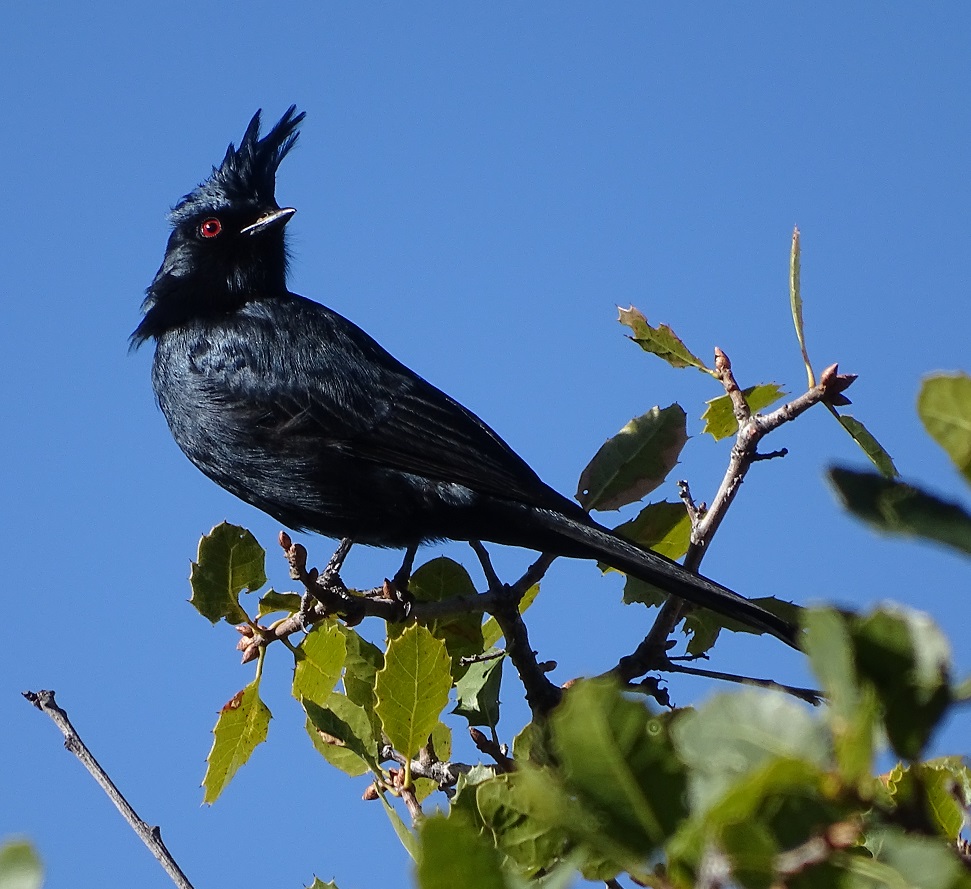
Phainopepla (Phainopepla nitens)

A lot of people hear the ascending "whiip" call of the phainopepla but do not recognize this visitor to our mountains. They usually pass through during spring and fall migration with few lingering in the winter. Those who do stay can be found where mistletoe berries are abundant.

Evening Grosbeak (Coccothraustes vesperrtinus) from The Sibley Guide to Birds

I love to write about successful bird chases. A few days ago, I dashed off to find the reported sighting of a small flock of evening grosbeaks. You get to see the drawing from Sibley's field guide since I couldn't find this uncommon visitor to our area. You can see on the map where it's normal range is located. We are in the green zone which means rare sightings.

Acorn Woodpecker (Melanerpes formicivorus)


These were taken yesterday during a brief moment of blue skies.

 Today, the gray clouds have shrouded the mountains and snow is falling. I admit I don't plan on going out today. It's much cozier being inside with a cup of hot tea writing a blog and dreaming of spring.

A huge thanks to our friends who are still going to work at the hospital and the grocery store every day!!
Wishing you all good health during these difficult days!

Photos and content by Robin Roberts


Saturday, February 15, 2020

King of the Lake

Lake Fulmor, a small lake outside of Idyllwild, is a place that people like to fish and picnic. I don't visit here often but I made sure to come this week after I received another birding tip....
My friends, Dave and Barb, told me that a fishing bird was seen skimming and diving into the water. Could it be one of my very favorite birds? The Belted Kingfisher? I have never seen a kingfisher in our mountains so this would be a great sighting for me.
Luck was definitely on my side! I arrived 15 minutes after getting the tip about this fun bird and I found it. The challenge was trying to get a photograph! You can see from the photo that this is a very small lake. Most people would call it a pond. I followed this bird up and down the side of the lake for 1 1/2 hrs. Just as I approached for a photo, it flew to the far end of the lake. This comical activity occurred over and over. I would walk close to the king of the lake and she would fly to the other end.
This was my final photo of the day before the sun disappeared. I was thrilled to see this beauty.

Today, I returned for another look at this rare sighting in the mountains. It has been only a few days since I saw the kingfisher so I expected to see it again but no luck today. It must have been passing through the area and left for another fishing hole.

Instead of the kingfisher, I was dazzled by the colors of a resident pair of Mallards. It is easy to take these ducks for granted since they are quite common. Now is the time to enjoy their spectacular feather colorations. So the lesson in this blog is that if someone gives you a tip on a really cool bird that you want to see, go immediately! Don't wait several days for it may disappear before you arrive.

Click on photos to enlarge.
Photos and content by Robin Roberts.