Tuesday, January 15, 2019

Winter Birding

Snow is falling in the San Jacinto Mountains. When the storm ends and the clouds depart, we will be able to see the snowy mountains. Waiting for the unveiling of the mountains is like opening up a surprise present.
Lesser Scaup
So while we are waiting to see how much snow has fallen, I want to share some more winter bird sightings. Ducks in breeding plumage are a welcome sight in the winter. Many times, they are distant silhouettes bobbing along in the water but the following photos are birds that were close to shore.
Cinnamon Teal by Adam Roberts
It isn't very often that we are able to find beautiful Cinnamon Teals especially close up. Ducks vary in their foraging techniques. Some are dabblers with their bill slightly underwater like this teal, others tip up their bodies with their heads underwater like Mallards while others dive underwater for their meals.


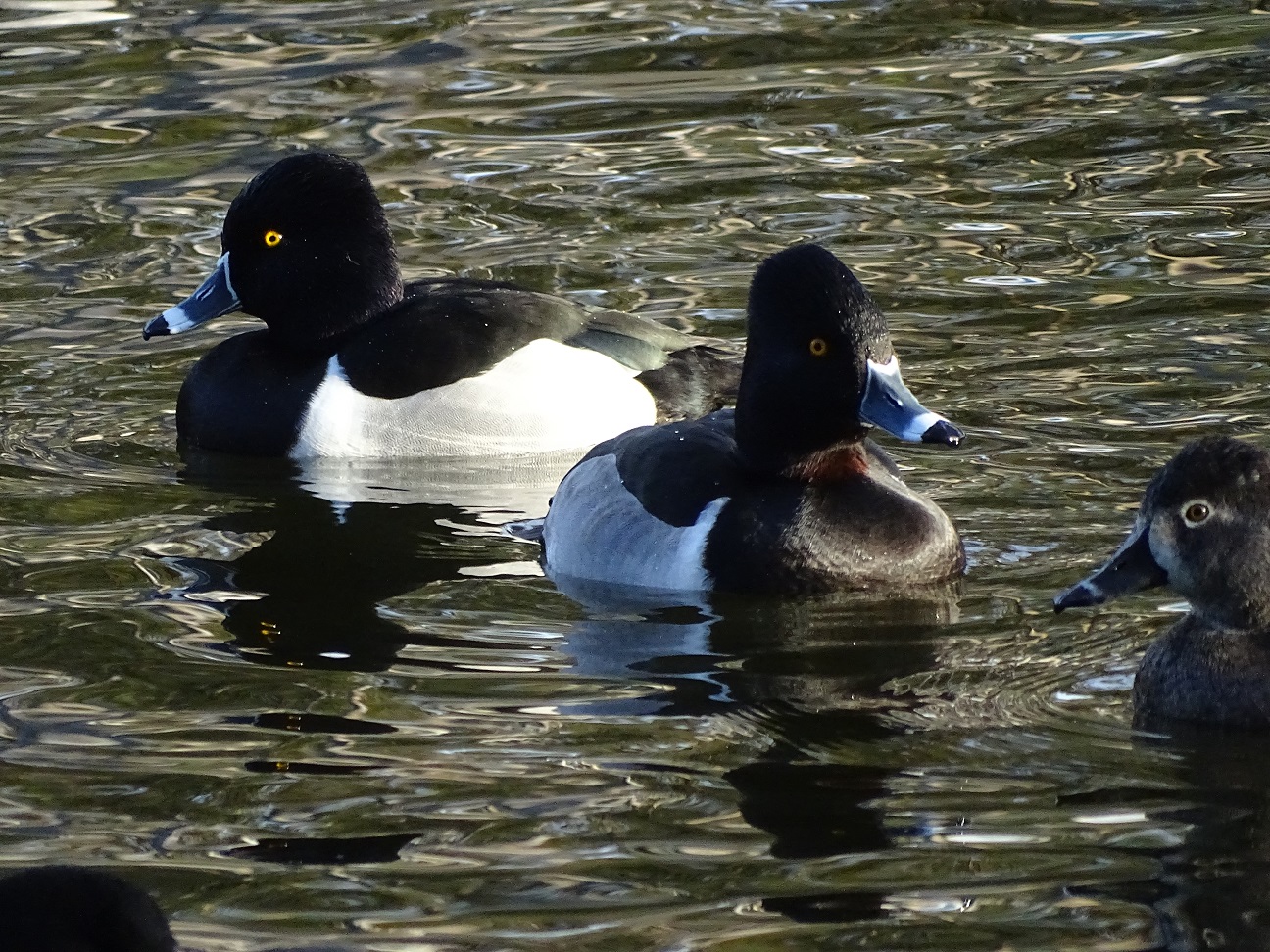
The Ring-necked Ducks and Green Winged Teals were striking.


The Northern Pintails were my favorite ducks of the day. These long-necked males bobbed their necks up and down quietly calling as they paddled up and down the lagoon.

As we were leaving, about 20 of these fruit-eating Cedar Waxwings flew directly overhead.


San Elijo Lagoon is one place where people are actively working on restoring habitat along the busy coast. Not only do these efforts benefit birds, native plants and other wildlife but it gives all of us a quiet place in nature to explore and enjoy.


As we returned home through the ranch land in Garner Valley, we found a perched White-tailed Kite. This kite and the Ferruginous Hawk are usually only here in the winter. What a great sighting! It was catching the last rays of the sun while peering on the ground for a final meal of the day.
Winter is a great time to look for breeding ducks and visiting raptors.
Happy Winter Birding!

Photos and content by Robin Roberts
Click on photos to view enlarged


Thursday, January 3, 2019

Exploring the Desert

Winter in Anza-Borrego Desert and nearby Salton Sea are quite popular places. Just ask any "snowbird" from the Pacific Northwest, Canada or Europe. You can also verify by observing the vast number of Jeeps and dune buggies cruising the vast landscape.
The wintering birds love it, too! They have their own followers like me.
Our post-Christmas trip to the desert began with sighting one of my very favorite winter residents. Fortunately, the road leading from Idyllwild to Borrego Springs wasn't too busy so we could abruptly do a U-turn once I spotted this magnificent Ferruginous Hawk on a telephone pole. I rarely get to see them so this was a great find.
If you are a birder, you already know that telephone wires and poles are great places to spot birds especially hawks and kestrels. As you can see, we spotted a smaller Red-tailed Hawk on another pole. It became suspicious when we tried the same U-turn maneuver to "capture" it. Immediately after this photo, it flew down the road to avoid us.
When you see this Yeti, you know that the desert is just a short drive away. 

Since we arrived close to sunset, there wasn't much time for any birding but we were able to find a mammoth size scorpion and a dragon. Not bad for the first day! Thanks to the artist, Ricardo Breceda, the desert is full of his amazing sculptures.
The challenge before us this holiday week was to find a place to hike in solitude without Jeeps or dune buggies.


We found a superb hike through a slot canyon. Despite the hundreds of Jeeps and buggies, we had this place to ourselves! What a beautiful spot!
Searching for some of my favorite desert or Salton Sea birds was also on the list. Note the signage under the Great Blue Heron! I'm sure he ignores all signs.
 The Burrowing Owl at Sonny Bono Wildlife Refuge posed for me as it usually does when I visit.

Belted Kingfishers usually fly off rattling before I get their photos. On this day, however, they both seemed more intent on staying perched overlooking their fishing holes. Great for me!
The desert has always been filled with adventurous people now and years ago. We were determined to find the historic monument to Pegleg Smith, 1801-1866. According to Pegleg, he found black covered gold nuggets in the area but was never able to rediscover more of them. The legend grew as did the people who tried to find his lost gold. The sign reads "Let those who seek Pegleg's gold add ten rocks to the pile." There is a huge rock pile behind this sign.
Finally, the last bird I photographed on this trip early in the morning just as the sun was peeking through the rain clouds was a Cactus Wren. He and 2 other local wrens were singing their hearts out to each other. Appropriately named, he was perched on a cholla cactus without any trouble.

There are lots of reasons to visit the desert or the Salton Sea. Enjoy!
If you visit Sonny Bono National Wildlife Refuge, be sure to pack out your trash due to the government shutdown.

Photos and content by Robin Roberts.
Click on photos to enlarge.


Sunday, December 23, 2018

Chasing Birds at Christmas

Chasing down a bird that you've never seen before is part of the thrill of birding. When a  new bird shows up in a nearby location unexpectedly, it's hard to resist. For many of us, there are too many restraints like a job, school, family or lack of funds to drop everything in search of the bird. However, if everything aligns just right so that you can go off on the adventure, there is no guarantee the bird won't use its wings and fly off before you arrive. But, if you find the bird, aaaahhhh.....it's worth it!
My own bird chase began 2 weeks ago. White-winged scoters were seen at the Salton Sea. They aren't regularly seen here so off we went on a 4-hour roundtrip trek to this birding hotspot in the desert.

When we arrived, we found hundreds of Bonaparte's gulls circling in the water and dipping their beaks to the surface of the water. These winter residents spending their breeding season in northern Canada and Alaska.
Hundreds of probing Black-necked Stilts filled the shorelines.
We found the resident Green Heron along its crowded pond but no scoters.
When you don't succeed with your "chase" bird, it's best to go to plan B. In our case, Dos Palmas, a remote oasis managed by the Bureau of Land Management, BLM, was a great option.

We parked our car at the gate and walked over a mile to the distant beckoning palm trees. As we walked along this desolate dirt road, we could envision the early traveler's stagecoach stopping here for respite.
The ponds here are managed to benefit the rare desert pupfish and Yuma clapper rails but this protected wetland habitat benefits lots of wildlife. This time of year, Ring-necked ducks and Canvasbacks are a few of the wintering ducks that have found refuge here. While we were in this remote, desolate spot, we came across another birder from the Desert Cities Birdclub! What a fun surprise! Obviously, birders are attracted to the same places.
We left this beautiful spot without our "bird". A few days later, we discovered on Ebird that our scoters were seen again. The challenge was before me. Should I spend another 4 hours traveling in hopes of finding these birds again? They aren't even colorful! What about the million things I should be doing instead with Christmas coming? Mmmmm....Sure, why not! Off I went but this time, I was by myself.
If I wasn't successful, at least I could buy more delicious dates from the Oasis Date Farm. Yum!
Luck was on my side. On a clear, sunny warm day at the beautiful Salton Sea, I found a male and female White-winged Scoter. This distant shot is not too impressive, I know, but it is special to me. If you have ever searched for birds, gold, Loch Ness monsters or Pokemon Go characters, you know how content I felt.
White-crowned Sparrow

Another type of bird chasing and counting has been occurring over 100 years. People from all over the country participate in the annual Audubon Christmas Bird County. Last Sat, Idyllwild held its CBC. Our group of birders found 110 species. It's not too late to join a CBC. They are lots of fun! One of our counters, Jenn Hajj wrote a beautiful Christmas song all about doing a Christmas bird count. She gave me permission to post her video here. Check it out! It will make you smile! Enjoy!


Photos and content by Robin Roberts.
Click on photos to enlarge.


Monday, December 10, 2018

Change in the Seasons

Change is happening! No longer are the trees covered in golden leaves. Only a few remain. Most importantly, the rain and snow have returned! Yahoo! This past week, we had overdue rain for 2 days in Idyllwild and snow in the higher elevations. I could hear the trees gulping up the water. Well, I almost heard them.
This is my favorite photo during the rainy days. A Northern Flicker found refuge on our fence under the eaves sheltered from the heaviest rain.
The fun part of being "socked in" by clouds during a rain event is the curiosity about what is happening in the high country. This week, when the clouds disappeared, snow was revealed at the highest elevations. Fantastic! We have yet to have snow fall in Idyllwild but hopefully, it is just around the corner.

Thanks to some very generous local philanthropists, we now have a park in the center of town. Since Thanksgiving, it is full of Christmas scenes and one of the tallest trees is covered in beautiful lights.
Recently, a mural was dedicated to the community by a grateful artist. He honored the firefighters that prevented our town from being destroyed in the July wildfire. Driving off the mountain, we are continually reminded of what was lost during that fire and what remains.
Fortunately, nearby Lake Hemet in Garner Valley survived. 
The presence of familiar wintering and resident birds is reassuring.


This White-tailed Kite is a wintering visitor. It is really fun to watch. It hovers in the sky before dropping down on its prey.
The resident Bald Eagles are still hanging around. They will have lots of eyes watching them starting next week as they begin to add sticks to their nest for a new season of raising a family.

Mudslides and debris flows are a concern this winter since the nearby mountains were burned in the July wildfire. So far, little damage has occurred. Changes have occurred in the campground. Part of the shore is now muddy and this once green, grassy area is now covered in several feet of mud. The retention wall used to hold in the water but now it cascades over the edge.
These Horned Larks seem to like the new landscape.
We are truly grateful for this little community, the special people who live here and the wildlife that still survives. Hopefully, my next post will be about the search for a rare scoter.

Click on photos to enlarge.
Photos and content by Robin Roberts.