Tuesday, May 17, 2016

Two Pots of Gold

It's not too often you get a chance to see a rainbow and even less often, you get to see two rainbows. When the storm clouds moved in, we could also see glimpses of the sun....ingredients needed for a rainbow.
Wow! We have never been so close to such a vibrant rainbow!

Just as quickly as they appeared, they disappeared. Special and unexpected.


Thursday, May 5, 2016

Prevent a Death Trap

For someone who spends her free time studying birds, "chasing" birds, and photographing them whenever possible, it was quite upsetting to find a bird in jeopardy in her own backyard bird feeder! I feel compelled to share my story so noone else has the same experience!
This past week as I gazed out the window, I noticed strange behavior at one of the bird feeders. A House Finch fluttered its wings while eating but wasn't going anywhere. I went outside to investigate and immediately discovered that its head was trapped in the feeder.
First of all, do not buy this feeder! It was a good deal at a national hardware store but it definitely has faults!

Instead of the small hole designed for the beak of the bird, a piece had fallen off creating this huge gaping hole which was not intended to accommodate a birds head. I knew from my bird banding class that birds get stressed easily when trapped or handled so I needed to react quickly but carefully! I removed the feeding perch and gently removed the helpless bird from the "death trap". I was expecting a well deserved "nip" from this little guy but he must have sensed I was trying to help and refrained himself.
He was stressed from the ordeal. I was afraid he wouldn't survive but after about an hour of just resting in the grass, he started to hop about. A few other House Finches started calling to him from a nearby fence when he started moving. It seemed to motivate him into action for shortly afterwards, he flew up to this "safe" feeder. Whew! He survived another day! The lesson in this story is to take care of your bird feeders. Clean them regularly and when you do, inspect them for sharp edges or faulty feeder perches like the one I mentioned.
Another preventable hazard to birds is window collisions. If you have bird feeders, assess the nearby windows. If they reflect the environment, birds may unknowingly fly into them resulting in death. I just put up some new decals in most of my windows. This style claims to refract the light spreading UV colors beyond the actual sticker giving greater protection. There are other designs available.
Trust me, it is far better to obscure the view out your window then to find a dead bird on the ground!
Enjoy the birds that visit your yard but be diligent in preventing potential death traps!!!


Friday, April 22, 2016

Spectacular Birds are on the Move

Ceonothus
Paintbrush

Lupine
 
Yucca
Blooming wildflowers, yuccas and shrubs are not the only colorful sights on the mountain. New birds are showing up every day! Spring migration is in full force!!
Some of the birds that recently arrived will be here all summer. Last week, the Black-headed Grosbeak arrived in our yard with his beautiful voice.
The Ash-throated Flycatcher with his soft referee whistle also arrived last week. His whistles will fill the air until the end of Summer.

Western Kingbirds perched on barb wires represents the start of Spring for me. They are some of the earliest arrivals for the season.
Nashville Warbler
There are plenty of birds that still have a long journey before them. If you want to witness the spectacular migrating warblers, you need to grab a pair of binoculars and look up high in the trees or in a "watering hole". If you have a water dish with moving water, your odds are increased for seeing one of these amazing birds. Unlike birds that come to your feeders filled with sunflower seeds, warblers prefer devouring insects, spiders and worms to sustain them on their journey north.
We returned to the Cedar Springs trail in hopes of finding some warblers. We found lots of them! Black-throated Gray, Townsend's, Hermit, Orange-crowned, and a Wilson's Warbler.
Black-throated Gray Warbler
Since most of them preferred to be gleaning insects from the leaves high in the trees, it was tough getting a decent photo of these active birds. We were happy to even spot them through the foliage.
We were both shocked and thrilled to find the same warblers the next morning in the Black Oak tree outside of our window. No hiking necessary...Lucky us!! The Townsend's Warbler has not been recorded breeding in California so this little bird is on his way to the Pacific Northwest! He still has a lot of miles to cover!
The Hermit Warbler has less miles to cover since he may end up in the Sierra Mountains. When he arrives at his destination, he will spend most of his time at the top of the tallest trees. I was quite fortunate to get his photo!!! It is both exciting and sad to see these warblers. Sad because most of them will only be here a day or two before heading on.
On the same day and in the same Black Oak tree, a couple of these absolutely gorgeous Western Tanagers showed up!!! Instead of continuing north, they will make these mountains their home for the summer. Yeah!
Welcome Back!!!

Click on photos to enlarge them.
Photos and content copyrighted. Robin Roberts


Sunday, April 10, 2016

Unusual Sightings On and Off the Hill


The most unusual sighting this week is definitely the fork-tailed Chuckwalla. We found this mighty handsome lizard at Joshua Tree National park. It's always a great surprise to see one of these huge desert lizards but to see one with a fork-tail was a FIRST! 
I love finding lizards especially the ones in the desert. The next great find of the day was another big lizard, the Desert Iguana. He caught our attention by the rustling noises in the underbrush. Eventually, we found out who was making the noise when he cautiously emerged from his shelter.
The most beautiful bird we found "off the hill" was the Vermillion Flycatcher. Unlike the East coast, where the beautiful red Cardinal is a common sight, there are few birds in the southwest dressed in red.
 When migrating birds start passing through and the birds of summer show up, you know Spring has arrived. For us, it started with the migrating Rufous Hummingbird. This beautiful hummer annoyed our resident Anna's Hummingbird by his presence but after a couple of days, he departed. Early in the week, we spotted the Violet-green Swallow which helps take care of the insect population all summer. A couple of days ago, the orange and yellow breasted Black-headed Grosbeak showed up at our feeder. He will fill the early morning hours with his beautiful American Robin like song.
Welcome, Spring!!


Wednesday, April 6, 2016

Life on the Cliffs - Torrey Pines State Natural Reserve


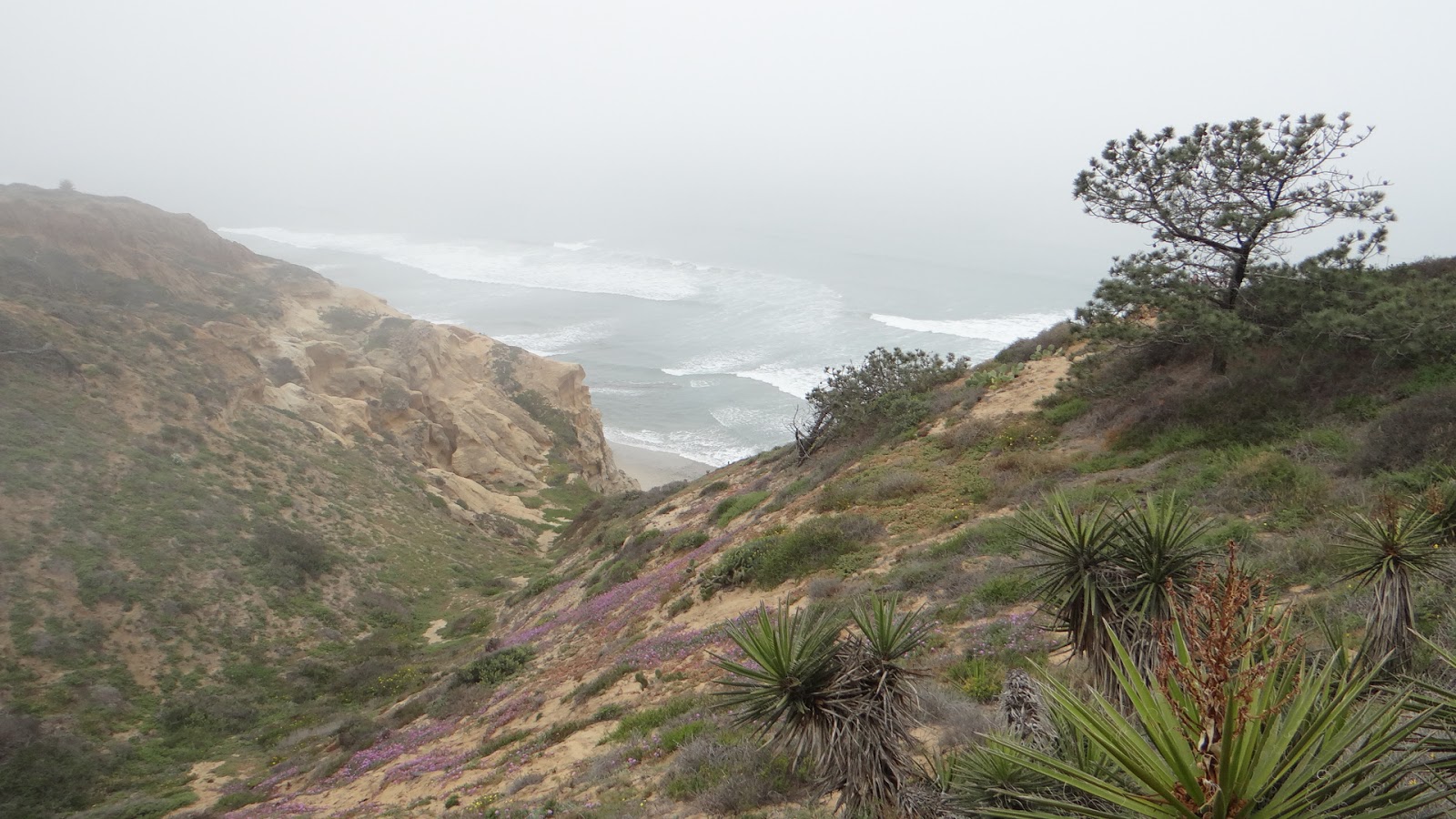
Hiking the trails along the cliffs and beach at Torrey Pines in San Diego is a unique experience. It's named for the rare Torrey Pine tree which is found only here on the cliffs overlooking the ocean and off the coast on Santa Rosa Island.
We arrived mid morning on Saturday, peak time for hiking, running, surfing, paddle boarding and hang 
gliding. Although the marine layer shrouded the views, no one seemed to mind.
We were in search of some solitude for an opportunity to see some birds and stop to take photos. Instead of the "beach trail" which everyone takes, we found a trail with few people. To quote Robert Frost, "Two roads diverged in the wood, and I took the one less traveled, And that has made all the difference."

Our chosen path was full of wildflowers overlooking the Pacific Ocean. Wow! Quite inspiring! Wished I had a sketchbook and colored pencils to capture the moment. Drawing takes more time and concentration than photography so you notice details more clearly.


When the tide receded, we were able to walk the beach. The only shorebirds we saw were Willets. They look quite different in their breeding plumage.

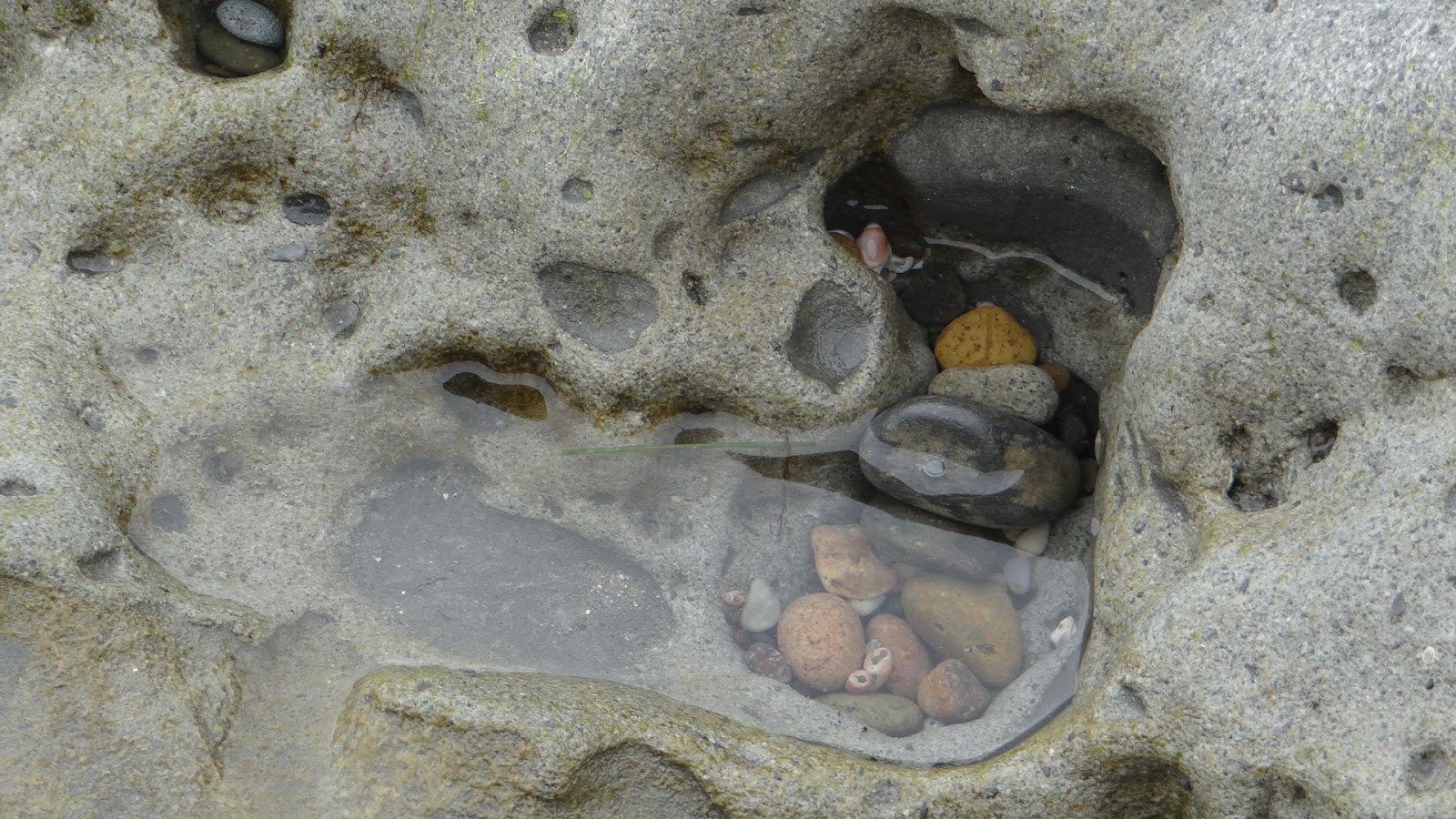
The cliff formations are fascinating with their various shapes and colors.
I  scanned the cliffs for the Peregrine Falcon that we had seen when we were on the trails overlooking the ocean. Eventually, we found the fastest bird on earth high above the beach on a favorite rock.
After a short time of perching, it returned to a secretive spot, presumably a nest at the edge of the cliff.
Many thanks to Guy Fleming for his dedication to preserving nature in the 1920's! Without his inspiration and hard work, this place would not exist today.