Wednesday, October 16, 2013

Discovering Zzyzx in the Mojave Desert

 Various images come to mind when one thinks of the Mojave Desert. For many, it is a place where the open landscape has sparse vegetation without life and an endless highway in the middle of it.
In reality, this unique place is full of diversity beginning with the geology. The vast desert with plants that have adapted to this arid environment is surrounded by rugged mountain ranges, volcanic formations, underwater rivers, natural springs, playas (dried lake beds) and sand dunes. These varied habitats provide homes for mammals, reptiles, insects,birds and amphibians.

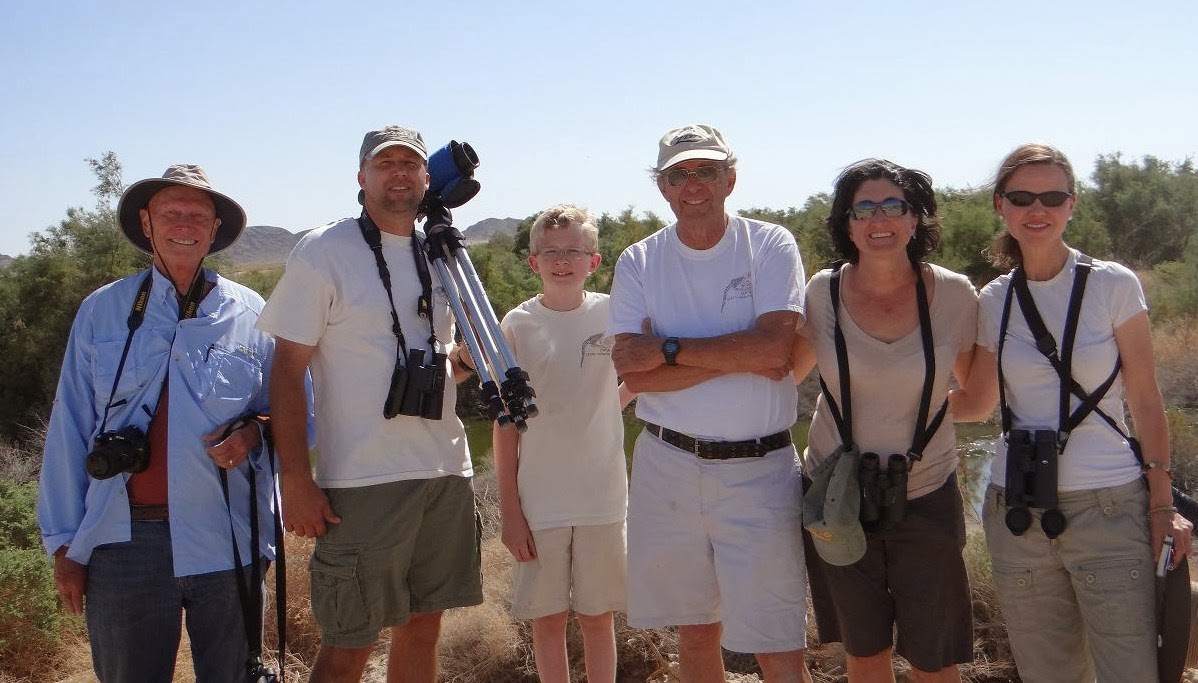
Choosing it as a birdwatching destination may seem strange. But, that is exactly why a group of us spent the weekend at the Desert Studies Center at Zzyzx in the Mojave National Preserve.


 Before the California University system opened this center, Zzyzx was created by entrepeneur, Curtis Springer. He enticed people to come to his resort to bathe in Mineral Springs and to drink his health tonics.
Before Springer, there was a salt mine. Petroglyphs show the presence of early Native Americans. Zzyzx has a rich varied history.
How do you find migrating birds in the desert? You pretend to be an exhausted bird flying overhead looking for a green patch with water where you can rest for a day or two.
With that in mind, we stopped at numerous places that would look attract migrants.
In one small creek, we saw a flock of Green Tealed Ducks. In another spot, we saw a Pectoral Sandpiper.
 From the breeding grounds in northern Alaska to the wintering grounds in South America, this bird travels incredibly long distances. The biggest surprise for us all was to see the Georgia state bird - the Brown Thrasher. It was quite strange for me to see this familiar bird in a tree in the desert overlooking a playa.

We traveled to places with neat names like Shoshone and Tecopa.

In Shoshone, we saw Dublin Gulch. A place where miners hoping to find silver in nearby mts carved their cave like homes out of the hardened volcanic ash in the late 1800's.

Another stop was China Ranch, a date farm in the desert. A great place for both birds and humans to visit.
The best birding trips included unexpected discoveries.

We saw signs that the Bighorn sheep were nearby. Then a herd of them appeared on the rocky escarpment behind Zzyzx. We forgot all about birdwatching while these majestic animals were watching us.

Traveling through the Mojave Preserve means slowing down for the endangered Desert tortoise as well as the tarantulas crossing the road.
With over 1.6 millions acres within the Mojave National Preserve,
there is so much to see! I highly recommend spending time in this special place!


Tuesday, October 8, 2013

Early Autumn

 For me, the first sign of Autumn has always been the changing colors of leaves. The Black Oak trees have begun to change colors this past week. These trees are surrounded by the Evergreens that dominate the landscape.

A new sign for me that Autumn has arrived is the filling of acorns into tree trunks by the Acorn Woodpeckers. Thousands can be found up and down a "granary" tree. Quite impressive!

 There are other busy woodpeckers. Today I saw both  White-headed woodpeckers and the Nuttall's woodpeckers which are endemic to California.They seemed to enjoy the same spots on specific trees for they followed each other back and forth as I watched. At one point, they sat side by side on a branch.

My favorite is the one dressed in spots and stripes - The Northern Flicker.
 Some days, finding a bird leads you further and further down an unknown path. When we heard the beautiful flute like song in this meadow we found ourselves being led by an elusive bird which continually flew away from us and kept itself hidden in the tall grass.
Eventually, our persistence paid off and the Western Meadowlark landed on a fence post for us to enjoy.
Some days, I get an unexpected surprise. This magnificent Red-shouldered hawk landed on a branch outside my window this week!

I couldn't have picked a better spot for these Western Bluebirds to land - another special moment.
 There are lots of changes to observe during this season.
I look forward to seeing and sharing views of Autumn in the different places that we live and visit.


Monday, September 30, 2013

Stories from the Lookout

"Stories from the Lookout" was inspired by the people we met while we volunteered in the tower this weekend.
Along with a huge number of visitors to the tower, this weekend was different than others because we saw white smoke billowing above the trees each day. Fortunately, the smoke flareups were in the burned area from the Mountain fire. They subsided each day without spreading outside that area.
Usually, the peak is a place of solitude but on Saturday, we had 120 visitors/hikers to the tower.
Two people I met had great fears of heights so reaching the summit was a huge accomplishment for them.
 Another man knew the geography of the surrounding mountains and all the hiking trails because he led Boy Scouts on backpacking trips in this wilderness every summer.
One visitor ran over 4 miles on the moderate/strenuous trail while another hiked up barefoot.
What struck me most was unexpected acts of kindness. It started with two of our new friends bringing us 6 liters of water and apples from their apple trees. When you backpack, water is gold. It is essential to carry but quite heavy. We were most appreciative of their generosity!
Later in the day, we met 5 members of the California Conservation Corp who were living and working on trail maintenance for months on the mt. We gave them one of our bottles of water. Then they offered us some coffee which we gladly accepted since our "instant coffee" didn't taste like coffee.
Another act of kindness came from a couple who offered to pack our trash out for us. They regularly pick up trash they find on the trails and they wanted to lighten the load for us when we departed. Wow!
On our last day, we met a very enthusiastic hiker who volunteered to carry items we might need to do maintenance on the tower and he offered to bring extra bottles of water for us when he comes up again.
When your backpack is heavy and you have a strenuous hike, all of these offers that may sound small are actually huge acts of kindness! These people were inspiring to us.

Monday, September 23, 2013

Hunting for "Life Birds"

Since arriving on the West coast, I have been filling my nature journal with new sightings of birds (and lizards,snakes,insects, mammals) adding to my "life list". Birders use that term when they see a new bird for the first time.
During migration, whether it is Spring or Fall, birds will pass through an area temporarily on their way to their wintering ground. This gives birders like me a chance to go on a treasure "bird hunt" looking for new birds.
It is truly exciting when you look in a tree or bush and see a bird that you've never seen before like this Orange-crowned warbler. For me, getting photos of birds is a huge accomplishment.
Most warblers like this Hermit's warbler are Neotropical birds meaning they migrate to Central and South America for the winter returning to North America to breed each year. Some birds travel thousands of miles each year during migration.
The Black-throated Grey warbler is another migrant. Most songbirds will migrate at night for 8-10 hours. Then they seek food, rest and shelter for a day or more along the way giving us a chance to see them.

Seeds,insects and berries like this Chaparral Honeysuckle are a welcome sight. Many times you can find migrants mixed in with local birds. Most of the warblers that I have seen were mingled in the tree or bush with a flock of Mountain Chickadees or other resident birds like the Pygmy Nuthatches.

Many birds are residents year round but if they are elusive and don't visit bird feeders, it is hard to see them.
This Red-breasted Sapsucker is one of those birds. When I was least expecting it, this woodpecker came into the open on a nearby branch. Wow!
When birdwatching isn't going so well, there's always other cool stuff to see like this dragonfly. I was watching about 10 green and blue Common Green Darner dragonflies which are migratory zooming back and forth over this meadow near the lake. (They are worse than warblers to photograph.) Then I saw this golden winged dragonfly land. I'm not sure what it is called but the wings sparkled in the sunlight. Time to write in my journal. Enjoy the treasures that surround you.
 
 Autumn is a beautiful season full of changes. If you would like to share a nature photo taken from Sept - November 10, please send it to me with a description so I can post an entry in November from various places where we live and visit. We are looking forward to seeing photos from your "patch" in the world!

Tuesday, September 17, 2013

The Tower Smiles

There are many ways to spend your weekend. For us, serving as volunteers in the lookout tower on Tahquitz Peak is one of our favorite things to do on the weekend.
 

   There are seven lookout towers in Southern California that are maintained by volunteers. However, Tahquitz Peak Lookout tower is the only one in the wilderness requiring a 4 1/2 mile hike to reach it. This trip was more strenuous since extra tools and water were brought up so maintenance could be done.

 This trip we were reminded of how close the tower came to being destroyed in the Mountain Fire this summer. Many of the intersecting trails are closed because of the potential dangers to hikers where the forest burned.
 
 
 The tower endures tough winters every year with snow, ice and 50-60 mph winds. The goal this weekend was to replace the beams which hold the north facing shutter and to begin painting.
Of course, looking out for fires and checking weather conditions are always a priority.
When we completed our work at the end of the weekend, one of the volunteers said, "The tower is smiling!" We agreed! There is more work to be done but it is stronger than when we began.